

Dispersers, also known as dispersal agents or dispersal vectors, are organisms or mechanisms that facilitate the movement of seeds, spores, or other reproductive structures away from the parent plant or organism. The dispersal process is crucial for the survival and distribution of many plant and fungal species, as it allows them to colonize new habitats, escape competition, and avoid inbreeding. Dispersers can be classified into two main categories: biotic and abiotic. Biotic dispersers are living organisms that actively transport seeds or spores. They include animals such as birds, mammals, insects, and reptiles. These organisms often consume the fruits or seeds of plants and then excrete them in a different location, allowing for seed dispersal. Some animals also disperse seeds by attaching them to their fur or feathers or by burying them for later consumption. Abiotic dispersers, on the other hand, are non-living factors that aid in seed or spore dispersal. These can include wind, water, gravity, or even human activities. Wind dispersal, or anemochory, is particularly common in plants with lightweight seeds or structures that act as parachutes or wings, enabling them to be carried by air currents. Water dispersal, or hydrochory, is prevalent in aquatic or riparian plants that produce buoyant seeds or fruits. Gravity dispersal, or barochory, occurs when heavy fruits or seeds fall from the parent plant and roll or bounce away. Human activities, such as agriculture, gardening, or unintentional transportation, can also act as dispersal agents. The effectiveness of dispersers depends on various factors, including the characteristics of the dispersal agent, the structure of the seed or spore, and the environment. Dispersal can have both positive and negative impacts on plant populations. It can enhance genetic diversity, promote colonization of new habitats, and facilitate species interactions. However, it can also lead to competition, predation, or the colonization of unsuitable habitats. In conclusion, dispersers play a crucial role in the movement and distribution of seeds and spores. They can be biotic or abiotic agents that aid in the survival and dispersal of plant and fungal species. Understanding dispersal mechanisms is essential for studying plant ecology, conservation, and the dynamics of ecosystems.
Achetez et vendez des équipements Dispersers d'occasion chez FEC Assets. Nous offrons une large sélection d'équipements Dispersers de seconde main, remis à neuf et d'occasion pour les industries pharmaceutiques, chimiques, alimentaires et d'emballage. Consultez notre inventaire actuel d'équipements Dispersers d'occasion à vendre, ou contactez-nous pour vendre vos équipements Dispersers excédentaires par le biais de notre service professionnel de récupération des investissements.
Dispersers Fabricants
Armeco
Notre stock d'Armeco comprend 1 article référencé, classé dans la catégorie « disperseurs » ; il n'e
CAYUGA
FEC Assets propose 1 article CAYUGA d'occasion, répertorié dans la catégorie « diffuseurs ». Il est

Hockmeyer
FEC Assets propose 9 articles Hockmeyer d'occasion ; 8 sont actuellement en stock, répertoriés dans
Joshua Greave
Un article d'occasion de la marque Joshua Greave a été mis en vente sur FEC Assets ; il est actuelle

Myers
FEC Assets propose 8 articles Myers d'occasion ; 6 sont actuellement en stock, principalement des di
Reynolds
Un article Reynolds d'occasion a été mis en ligne sur FEC Assets ; il est actuellement en stock et f
Filtre
Catégories principales
(1)Catégories
(1)Année de construction
(3)Fabricants
(6)Modèles
(7)Localisation des sites
(2)Gainé
Numéro de série
Plans
Pression de la gaine
Récipient de mélange
Sous vide

2 Gal Reynolds Dual Shaft Vacuum Mixer System, Model 2/1 HP Lab Elect DSM
Système de mélangeur sous vide à double arbre Reynolds d'occasion, modèle 2/1 HP Lab Elect DSM, surfaces en contact avec le produit en acier inoxydable, équipé d'une pale de dispersion à grande vitesse entraînée par un moteur de 2 hp, d'une pale hélicoïdale à vitesse réduite entraînée par un moteur de 1 hp, d'un couvercle sous vide, cuve de mélange à double enveloppe pouvant atteindre le vide comp...
Reynolds - 2/1 HP Lab Elect DSM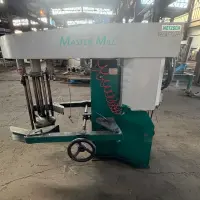
Netzsch Submersible Basket Mill, Model MasterMill 18, S/S
Broyeur à panier submersible Netzsch d'occasion, modèle MasterMill 18, en acier inoxydable, n° de série 2406, année de fabrication 2012.
NETZSCH - MasterMill 18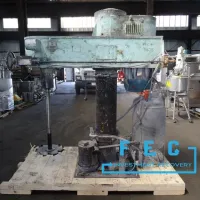
25 HP Hockmeyer Disperser, S/S, XP
Disperseur Hockmeyer 25 hp d'occasion, modèle HVR25, arbre en acier inoxydable de 2,5" de diamètre avec lame en acier inoxydable de 18" de diamètre, 25 hp, moteur xp 230/460 volts, vitesse variable, levage hydraulique air/huile avec réservoir d'air, monté au sol.
Hockmeyer - HVR25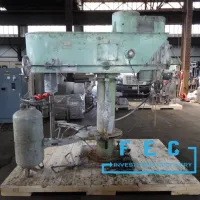
25 HP Hockmeyer Mixer, C/S, XP
Mélangeur Hockmeyer 25 hp d'occasion, modèle HVM-25, arbre en acier au carbone de 3,5" de diamètre avec (1)28" et (1)32" lames en acier au carbone, moteur xp de 25 hp, 230/460 volts, vitesse variable, levage hydraulique air/huile avec réservoir d'air, monté au sol, numéro de série 94-11-2824.
Hockmeyer - HVM-25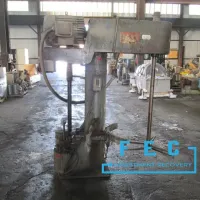
30 HP Myers Bow Tie Mixer, C/S
Mélangeur à vitesse lente Myers bow tie, modèle 350-30, arbre et lame en acier au carbone, moteur de 30 hp, 220/440 volt, élévateur hydraulique de 0,75 hp, 220/440 volt avec pompe, monté au sol, numéro de série 115.
Myers - 350-30
60/10 HP Joshua Greaves Dual Shaft Disperser, S/S, XP
Disperseur à deux arbres Joshua Greaves d'occasion monté sur une cuve, modèle D/Action, construction en acier inoxydable, agitateur à ancre monté au centre avec raclage de la paroi latérale entraîné par un moteur xp de 7.5 hp, 460 volt xp motor drive, off center high speed disperser driven by 45 kw, 460 volt, 1770 rpm motor, mounted on approximately 1800 liter stainless steel jacketed tank, 4'6" d...
Joshua Greave - D/Action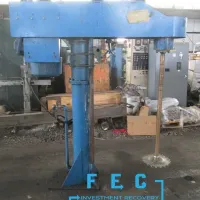
20 HP Cayuga Disperser, S/S
Disperseur Cayuga 20 HP d'occasion, modèle L7BVS19025, arbre et lame en acier inoxydable, monté au sol, numéro de série 7303051. Nécessite un réservoir d'air.
CAYUGA - L7BVS19025